
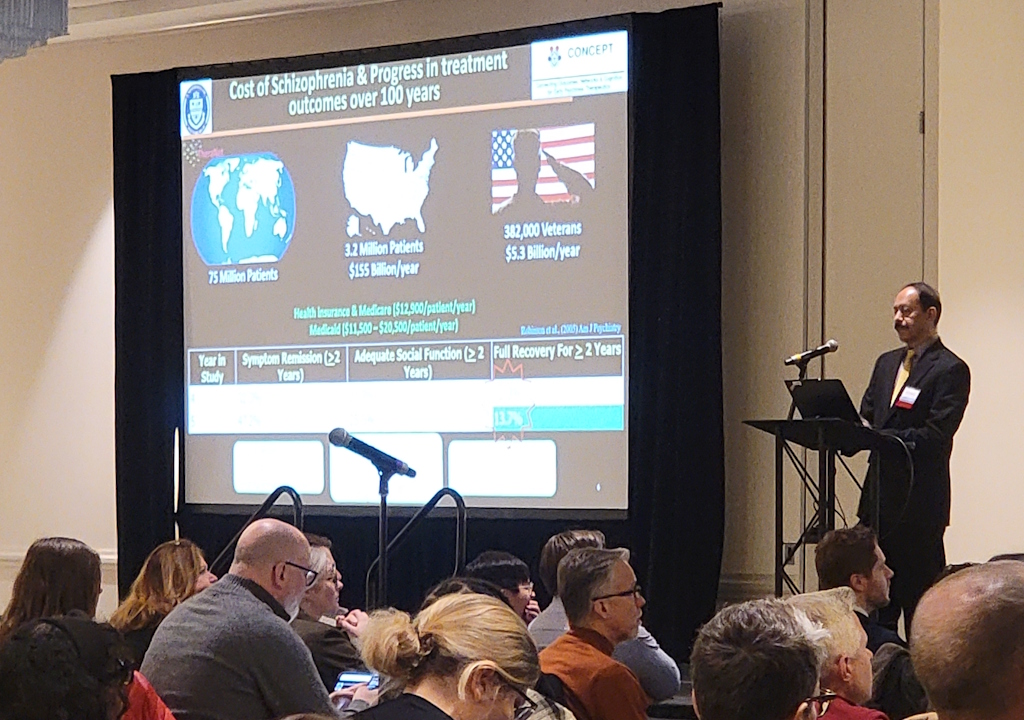
Pictured Above: Dr. Prasad discusses strategies to improve diagnostic reliability using artificial intelligence at the 42nd Annual Pittsburgh Schizophrenia Conference in 2025.
Research Basics
We support University of Pittsburgh graduate students, post-doctoral researchers, and medical students through our home departments of Psychiatry and Biomedical Engineering at the University of Pittsburgh. We employ fulltime staff through UPMC using merit-based grant funds. We rely on both data available online and locally collected data to study the biology of psychosis. Here are some of our current and past academic research endeavors.

The brain is constantly active and changing, yet many traditional brain-imaging methods give us a relatively static picture of how it works. Studies often average brain activity over long periods of time or examine connections between brain regions separately from the activity occurring within those regions. As a result, we may miss important moment-to-moment changes in how the brain organizes itself. Methods to assess state space include the maximum entropy model (MEM), hidden Markov model (HMM), and modern Hopfield networks (MHN). One way to think about these models is as a map of the brain’s changing landscape. The brain is constantly shifting from one pattern of activity to another, even when we are simply in an awake resting state. Some brain states are like deep valleys: the brain naturally settles into them and tends to stay there. Others are more like hilltops: they are less stable and less likely to occur.

AI, and more specifically, deep learning with neural networks has propelled researcher in new directions. While earlier methods to study brain-wide associations relied on many comparisons and normative assumptions about the underlying data, novel deep learning methods make fewer assumptions about the data and can often use the minimally preprocessed images as learning inputs. For instance, a study of the brain aging using 3D convolutional neural networks (3D CNN) has identified specific areas of the brain affected by age. Training AI with MRI data is an active are of research at the CONCEPT Lab, including 3D CNN and graph convolutional neural networks (GCN).

Graph theory is an important tool for neuroimaging research, where researchers have long relied on functional network of regional co-activation, or connectivity networks measured using diffusion MRI techniques. We use graph theory to bridge MRI data collected from different "modalities" like structural, functional MRI. These multiplex network representations allow for advanced machine learning and statistical analysis techniques to be used on the complex, high dimensional in-vivo MRI data.

Tissue imaging modalities such as T1w MRI provide exciting ways to study anatomical correlates of mental illness, such as regional volume and shape changes, or through the lens of structural covariance networks (SCNs).

MRI data and image processing provide the statistical data needed to answer research questions, and continue to be a mainstay of academic neuroimaging research. We use scripting languages such as Matlab, python, and bash, to denoise and prepare data for analysis, including multimodal registration.

Magnetic Resonance Spectroscopy (MRS) allows the chemical compositions of individual brain voxels to be analyzed. Proton ( 1H) MRS measures neurotransmitters while phosphorus (31P) MRS measures membrane phospholipid metabolites that index synaptic density and dendritic arborizations. A schematic of the biological basis of 31P MRS is presented above. Dynamic changes in neurotransmitters can be measures using 1H MRS allowing researchers to study the time -course of neurotransmitter changes during cognitive tasks, which may be an indispensable tool for understanding the role of neurotransmitter response associated with cognition and psychopathology.

High-performance computing is an essential part of data operations. In addition to a physical computer lab, we maintain a local cluster computer, and process data on both the University of Pittsburgh CRC and the PSC Bridges-2 systems.